At Unique Bags, GSM is the first thing we ask about once a customer has settled on a bag style, before size, before colour, often before price. That’s because non-woven bag GSM is the single biggest factor deciding whether a bag survives one trip home or gets reused for months. Retailers across Kanpur and beyond come to us with a style in mind, usually a D-cut or a loop handle bag, but the real conversation almost always turns into one about weight, not looks.
Here’s why GSM matters so much, how it behaves differently across D-cut and loop handle construction, and how we actually arrive at a GSM recommendation for an order.
What GSM Actually Means
GSM stands for grams per square metre – how much the non-woven polypropylene fabric weighs across a fixed area, not the bag’s size or thickness on its own. A higher GSM fabric packs more fibre into that area, which adds tensile strength and tear resistance. A lower GSM fabric is lighter and cheaper to produce, but has less material holding the weave together once a load is applied.
Two bags of identical dimensions and colour can behave completely differently once loaded-one holds its shape, the other stretches at the seams within a few uses. The fabric weight is doing that work quietly, behind whatever print or finish sits on top of it.
How GSM Decides Bag Strength
Bag strength GSM isn’t a fixed formula – it’s a relationship between fibre density and the actual load a bag is expected to carry. A bag for light promotional use doesn’t need the same fabric weight as one meant for daily grocery runs, and ordering heavier fabric than the use case demands just adds cost per piece for no real benefit.
Across years of bulk orders, we’ve noticed most strength failures – torn handles, split side seams, a base giving way – trace back to a GSM mismatch rather than a fault in die-cutting or stitching. The fabric was simply asked to carry more than its weight allowed. That’s why we spend time understanding what a bag will actually carry before quoting a GSM, instead of defaulting to whatever is cheapest to produce.
D-Cut Bags: Where GSM Matters Most for Handle Strength
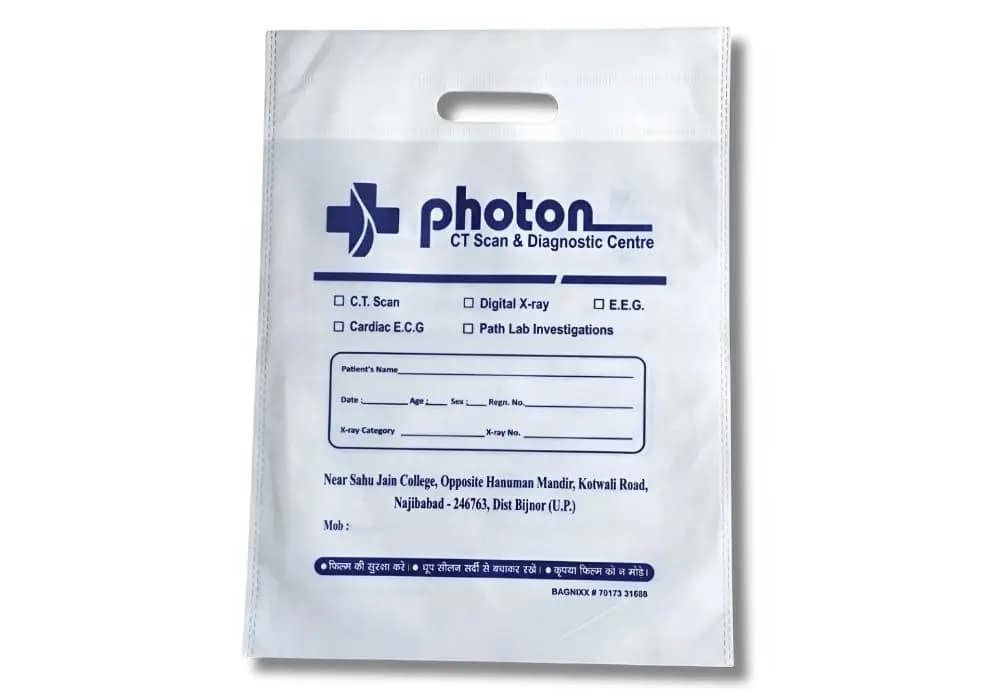
D-cut bag GSM deserves particular attention because of how the handle is formed. A D-cut handle is die-cut directly out of the same fabric sheet as the bag body – there’s no separate stitched handle reinforcing that stress point. The fabric around the cut-out carries the entire load through a shape with less material at exactly the point where a shopper’s fingers pull hardest.
Because of this, D-cut bags are noticeably more sensitive to GSM changes than other styles. A lower GSM D-cut bag works fine for light retail categories – telecom accessories, pharmacy items, small gifts — where the load rarely stresses the handle cut-out. The same low GSM under a heavier load, like a stack of garments or groceries, is where handle-tearing complaints show up most. For moderate to heavy loads, we typically recommend stepping up the GSM specifically to protect the handle area, even when the rest of the bag’s dimensions stay unchanged.
Loop Handle Bags: A Different Strength Equation
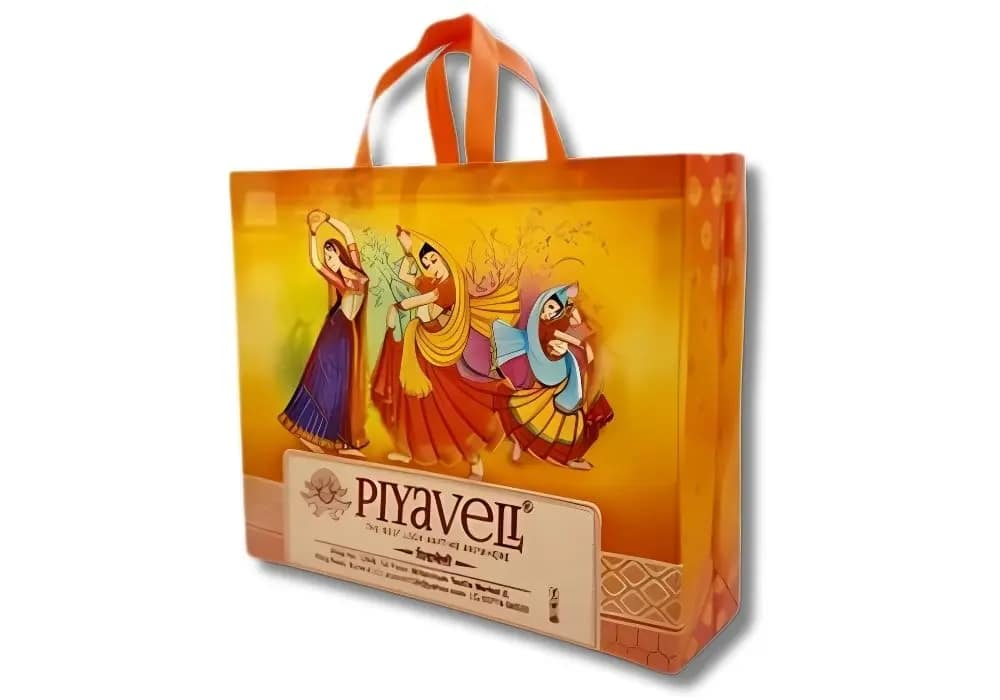
Loop handle bag durability works on a different principle. Because the handle is a separately stitched loop attached to the bag body, load stress is distributed between the stitching and the fabric weight, rather than resting entirely on a die-cut point. This is part of why loop handle bags suit boutiques, garment stores, and gifting use cases, where the bag needs to hold a heavier or bulkier load while still looking premium.
That said, the strength or resilience here does not negate GSM, so it only puts the impact in a different location of the product. A low-GSM fabric in a loop handle bag can still split at the bottom or side seams over time when weighed down, even if the handle attachment is sewn on with sturdy stitching. Loop handle orders for apparel, shoes, or bakery boxes perform better when a moderate to higher GSM is used with strong stitching at the handle attachment points.
Fabric Weight Bags: Matching GSM to Actual Use
Thinking in terms of fabric weight bags, rather than just bag style, is probably the most useful shift a business can make before a bulk order. The same D-cut or loop handle design can be manufactured across a wide GSM range, and the right choice depends on what’s going inside, how often it’s reused, and whether it needs to survive transit or storage before it even reaches the customer.
Patterns we see consistently:
- Light, occasional loads – accessories, small pharmacy items, single garments – do well on lighter fabric-weight bags, keeping per-piece cost down without a real strength trade-off.
- Moderate, mixed loads – a typical grocery or retail basket – need a weight that comfortably holds an irregular mix of items.
- Heavier or bulkier loads – multiple garments, footwear boxes, bakery packaging- benefit from higher GSM, often paired with lamination for added structure.
- Export or long-transit orders usually call for the top end of our GSM range, regardless of the final load, since the bag has to survive handling before it’s ever used.
How We Recommend GSM at Unique Bags
As most orders begin with a rough budget and style preference, we have to reverse engineer what the bag will contain. Which product group is it being used with, average basket size, single use or long term reusable? Based on this and size, we then propose a range of GSM rather than a single figure, as volumes, colours and printing can make a difference.
We manufacture non-woven fabric across the full GSM spectrum in-house rather than sourcing fixed-weight rolls externally – this lets us tune fabric weight to a specific order instead of fitting a requirement into whatever stock weight happens to be available.
Getting GSM Right the First Time
Choosing the wrong GSM is rarely obvious at the order stage – a bag looks fine on delivery, and the problem shows up weeks later when handles tear or customers complain about early wear. Getting it right the first time saves a business from reprinting stock or quietly losing repeat customers to a poor packaging experience. Bulk Purchase – D-cut & Loop Handle Non-Woven Bags: If ordering D-cut or Loop Handles in bulk and you’re not sure what GSM falls into your product load, give us a call at 8887995604. We’ll go through your general load and suggest an appropriate weight.
Frequently Asked Questions
1. What GSM is best for D-cut non-woven bags?
It depends on the load – light categories like accessories or pharmacy items do well on lower-to-mid GSM, while garments or groceries need higher GSM to protect the handle cut-out.
2. Does higher GSM always mean a stronger bag?
Generally yes for tensile strength, but “stronger” only matters relative to the load. Paying for GSM beyond what your products need adds cost without a practical benefit.
3. Why do D-cut handles tear more often than loop handles?
D-cut handles are cut from the body fabric, so load stress passes through one cut-out area. Loop handles are stitched separately, spreading the stress between stitching and fabric.
4. What GSM range does Unique Bags manufacture?
We manufacture non-woven fabric and bags across a full GSM range, from lighter weights for promotional and light retail use to heavier weights for export and heavy-duty packaging.
5. Can the same bag design be made in different GSM?
Yes. Both D-cut and loop handle designs can be produced across our GSM range – the design stays the same; only the fabric weight and resulting strength change.
6. Is heavier GSM automatically better for branding?
Not directly – print quality depends more on the fabric surface and printing method. Heavier GSM bags do get reused longer, though, meaning more repeat exposure for the branding.
7. How do I know if my current bags are the wrong GSM?
Recurring handle tears, split seams, or bags stretching out of shape after light use usually mean the GSM is too low for the load it’s carrying.
8. Does lamination reduce how much GSM I need?
Lamination adds surface durability and water resistance but doesn’t replace the base fabric’s tensile strength, so GSM still matters even on laminated orders.
9. Are loop handle bags always stronger than D-cut bags?
Not automatically – a low-GSM loop handle bag can still underperform a well-specified D-cut bag. Handle style and GSM both need to match the load.
10. Who can help me choose the right GSM for my business?
Unique Bags works directly with retailers and businesses across India to match bag style, GSM, and construction to their product range – call 8887995604 for a recommendation.